
Parental Alienation: Overview, Management, Intervention, and Practice Tips
Ground-breaking strategies for effective management of parental alienation cases
The University of Texas School of Law and the American Academy of Matrimonial Lawyers-Texas Chapter included this monograph-length paper in course material for a 2014 conference on custody litigation. The paper expands on Dr. Warshak’s previous work and presents a wealth of new material directly relevant to litigation of cases that raise parental alienation issues.
One of the most valuable sections presents the first comprehensive analysis of how and why temporary suspension of children’s contact with their favored parent can serve ten aims consistent with children’s best interests. The discussion explains how a no-contact order between children and alienating parents can make it easier for the children to heal their damaged relationships with their rejected parents. The discussion draws from Dr. Warshak’s experience in helping severely alienated children and adolescents successfully reunite with a parent whom they have unreasonably rejected. The rationale for no-contact orders has not appeared in this depth in any of Dr. Warshak’s prior publications and has never been described by other scholars.
The list and discussion of ten reasons why courts find it to be in children’s best interests to suspend their contact with the favored parent can inform what the rejected parent seeks from the court and provide arguments in favor of this position. Such arguments can serve as organizing themes in the presentation of the case, in opening and closing arguments, and in examination of witnesses.
Among the highlights of this paper: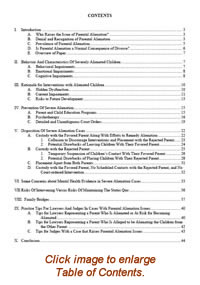
- detailed practice tips for lawyers and judges
- new material on hidden dysfunctions in alienated children who appear to be thriving and who try to convince evaluators and courts that the status quo is working for them
- a common provision in court orders, designed to safeguard children’s welfare, that often has undesirable consequences
- how counselors who lack adequate knowledge and skills for dealing with parental alienation contribute to the family’s problems
- responding to concerns that children will act out if the court requires them to reunite with a parent
- why young children exposed to alienating behavior by one parent need help even if they do not maintain chronic negative attitudes about the other parent
- cross-examining experts who testify that children will be traumatized if the court places them with their rejected parent
- the benefits of swift enforcement of court orders
- why judges should order parents to bring the children to the courthouse on the day the custody decision is announced
This paper incorporates some material from Dr. Warshak’s prior work: It describes common behaviors and characteristics displayed by severely alienated children and the harmful impacts of parent alienation on children’s current and future psychological development. These impacts provide the rationale for interventions to remedy the problem. The contributions of education, psychotherapy, and court orders to preventing alienation from developing or from becoming more severe are discussed. The paper describes the potential benefits and drawbacks of the four main options for courts in cases with alienated children. Some concerns about mental health evidence are discussed along with the risks of intervening versus maintaining the status quo in families with alienated children. Next is a description of Family Bridges, an innovative program to help alienated children successfully reunite with their rejected parents. The paper ends with detailed practice tips for lawyers representing a parent who is alienated or at risk for becoming alienated, tips for lawyers representing a parent who is alleged to be alienating the children, and tips for judges with a case that raises parental alienation issues.
If you have only one article to use in preparing a parental alienation case, this is it.
This journal article is included in Dr. Warshak’s forthcoming book, The Psychology of Alienated Children: When Children Reject Parents, Volume 1 of the Collected Papers of Richard A. Warshak. The book will be available in January 2026 and links for purchase will be on warshak.com.
The Psychology of Alienated Children conveniently brings together, in one low-cost volume, 15 of my most important papers on parental alienation. For some time, I have been concerned about the high cost to parents and professionals who want copies of certain published articles and book chapters. One chapter in this book is available only from its legal publisher through the subscription price of $976. Another chapter is unavailable at any price. The remaining 13 chapters would cost $562 if acquired from the publishers of the original papers.
The publisher of The Psychology of Alienated Children agreed to keep the price below $50 to be accessible to those who need this material. I hope this will be a useful addition to your library.
Because the article is part of the forthcoming volume, I can no longer offer the manuscript for download. If you cannot purchase the book, the article is available for purchase directly from the publisher, or you can ask your local public library to add it to their collection.